Nothing ruins a relaxing aquascape faster than watching last week’s fish food swirl through a cloud of mulm every time you wave the net. Deep cleaning substrate used to mean bucket-brigade water changes, wet arms, and the inevitable spill on the living-room rug. Today’s aquarium gravel cleaners—compact, battery or faucet-powered vacuums—turn that messy ritual into a five-minute, drip-free task while protecting the beneficial bacteria that keep your cycle rock-solid.
But wander down the online-aisle and you’ll see everything from USB-charged “mini wands” to dual-motor beasts that could drain a koi pond. Suction power, flow-control, anti-clog impellers, extension tubes, inline heaters, algae-scrubber add-ons—marketing copy makes every model sound like the “pro-grade” silver bullet. In reality, the best gravel vacuum for you is the one sized to your tank’s depth, substrate grain, livestock sensitivity, and your own maintenance routine. The guide below distills what seasoned aquarists actually measure, modify, and swear by so you can buy once, and then never think about gravel cleaning again—except on water-change day when you actually smile at how easy it is.
Top 10 Aquarium Gravel Cleaner
Detailed Product Reviews
1. Tetra Water Cleaner Gravel Siphon for Aquariums, Easily Clean Freshwater Aquariums

Overview:
Tetra’s $8.79 gravel siphon is the bare-bones, entry-level tool every new fish-keeper reaches for first. Designed for tanks ≤55 gal, it uses simple gravity flow to whisk away dirty water while lightly vacuuming the substrate.
What Makes It Stand Out:
Ultra-lightweight, zero moving parts, and a tiny footprint. The included priming bulb and bucket clip make this the fastest “open-box-to-tank” solution on the market—no batteries, hoses, or assembly charts required.
Value for Money:
Under nine dollars buys you a decade of dependable water changes. Replacement parts are universal, so the initial cost is essentially the lifetime cost.
Strengths and Weaknesses:
+ Fool-proof priming bulb
+ Stores in a drawer—great for dorm or office setups
+ No noise, cords, or electricity near water
– Hose is stiff and short; expect splashes on carpet
– Cannot start itself if the tank rim sits lower than the bucket
– Small bore clogs on sand or chunky driftwood debris
Bottom Line:
If you just need “get the gunk out” monthly without gadgets, this is the only tool you’ll ever require. Upgrade only when you crave faster flow or hands-free operation.
2. QZQ Aquarium Gravel Cleaner [2025 Edition] Vacuum Fish Tank Vacuum Cleaner Tools for Aquarium Water Changer with Aquarium Thermometers Fish Net kit Use for Fish Tank Cleaning Gravel and Sand
![QZQ Aquarium Gravel Cleaner [2025 Edition] Vacuum Fish Tank Vacuum Cleaner Tools for Aquarium Water Changer with Aquarium Thermometers Fish Net kit Use for Fish Tank Cleaning Gravel and Sand](https://m.media-amazon.com/images/I/51S+2N20RtL._SL160_.jpg)
Overview:
QZQ’s 2025 manual kit ($18.79) bundles a pressure-ball siphon, algae scraper, fish net, thermometer sticker, and segmented hoses into one plastic toolbox—essentially a portable service station for tanks of any depth.
What Makes It Stand Out:
The press-pump starts siphon instantly without mouth-priming or spill-risk, while the inline mesh cup blocks gravel yet lets mulled waste pass. Swap heads and you can rake sand, skim surface, or net stragglers in the same session.
Value for Money:
Comparable starter kits cost $25-plus and omit accessories. Here you receive six practical tools (and spares) for the price of two take-out lunches.
Strengths and Weaknesses:
+ Silent, battery-free operation—kid-safe
+ Telescopic tubes reach 17–34 in tanks
+ Mesh guard stops curious fry from emigrating
– Multiple joints mean more spots for bio-film leaks; occasional re-tightening needed
– Pressure bulb stiffens in cold water—expect 10-12 squeezes on first start
– Hoses kink if coiled too tightly for storage
Bottom Line:
For hobbyists who juggle sand, plants, and small fish, this inexpensive multitool earns its drawer space. Accept the minor drips and you’ll cut weekly maintenance time in half.
3. hygger 360GPH Electric Aquarium Gravel Cleaner, 5 in 1 Automatic Fish Tank Cleaning Tool Set Vacuum Water Changer Sand Washer Filter Siphon Adjustable Length 15W
Overview:
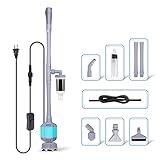
Hygger’s 15 W electric vacuum ($35.99) turns the traditional bucket brigade into a one-touch affair: pull the trigger and 360 GPH of water lifts waste, powers a shower head, or runs through an onboard sponge filter before returning clean water to the tank.
What Makes It Stand Out:
Four snap-together hard tubes reach from 11 in up to 40 in, so one device cleans a desktop shrimp bowl or a 120-gallon display. A duck-bill snout slips under rockwork without blasting plants away, while the brush head scrubs acrylic seams.
Value for Money:
Competing electric cleaners start near fifty dollars and skip the filter box. Here you receive a water changer, substrate washer, algae detailer, and micro-vac for the mid-thirty range—plus UL-listed adapter.
Strengths and Weaknesses:
+ Starts in 2 in of water—perfect for turtle tubs
+ Ceramic impeller tolerates sand grains
+ Flow-adjust valve lets you baby delicate carpeting plants
– Motor housing is splash-proof, not waterproof—do not submerge
– Detaching tubes when hands are wet needs grip strength
– 5 ft outlet hose is shorter than many stands are tall
Bottom Line:
If you maintain multiple tanks or dread lifting buckets, this 5-in-1 unit justifies every penny. Keep the motor dry, and it will outlast several generations of fish.
4. UPETTOOLS Aquarium Gravel Cleaner – Electric Automatic Removable Vacuum Water Changer Sand Algae Cleaner Filter Changer 110V/28W

Overview:
UPETTOOLS black-and-orange powerhouse marries a 28 W motor to a 1,700 L/H impeller, creating a gravel-cleaning hurricane that drains a 180-gallon setup in roughly half an hour—no buckets, no huffing, no spills.
What Makes It Stand Out:
The six-in-one head set includes a sand-washing bell, crevice nozzle, mushroom shower, and flow-adjust dial. A twist-lock telescoping wand grows from 24 in to 38 in, covering everything from shallow paludariums to 4-ft-deep cichlid mansions.
Value for Money:
At $35.99 you’re getting commercial-grade flow plus a three-year warranty backed by 24/7 customer chat—features normally seen on $70 units.
Strengths and Weaknesses:
+ Integrated 3-stage filter cartridge traps micro-crud yet keeps beneficial bacteria home
+ UL plug, water-resistant switch, and 48-month motor-life rating
+ Suction is strong enough to lift anchored driftwood mulch—dial it back for fry tanks
– Hose is 1.9 m; large outdoor stock tanks need an extension
– Motor hum is audible in silent rooms—about the level of a small HOB filter
– Heavier than manual alternatives—extended cleaning can tire wrists
Bottom Line:
Deep-water aquarists or anyone with back issues should skip straight to this model; it’s the closest thing to hiring a tank service without the monthly bill.
5. Aquarium Gravel Cleaner – Naturally Maintain a Healthier Tank, Reducing Fish Waste and Toxins (16 fl oz)

Overview:
This 16 fl oz bottle ($15.95) isn’t a vacuum—it’s a living culture of heterotrophic bacteria that colonize gravel, décor, and filter media to digest sludge between your physical cleanings.
What Makes It Stand Out:
By accelerating the nitrogen cycle and exporting nitrate/phosphate, the additive can stretch water-change intervals from weekly to bi-weekly in lightly stocked tanks while noticeably polishing water clarity.
Value for Money:
One capful treats 10 gallons, giving a 16 oz bottle a 960-gallon lifespan—roughly two pennies per treated gallon, cheaper than dechlorinator.
Strengths and Weaknesses:
+ Odor-free formula; safe for scale-less fish, shrimp, and snails
+ Reduces cloudy bloom after substrate rescapes
+ Can be dosed directly after siphoning to replenish bacterial beds
– Not a substitute for vacuuming heavy waste; large debris still needs mechanical removal
– Overdosing in oxygen-poor tanks can trigger transient cloudy water
– Treat time varies: lightly stocked tanks see results in 48 h; crowded cichlid systems may need two weeks
Bottom Line:
Pair this bacterial boost with any of the siphons above for a “clean less, enjoy more” routine. It won’t pull gravel clean, but it will keep ammonia spikes and funky smells from undoing your hard work.
6. Laifoo 5ft Aquarium Siphon Vacuum Cleaner for Fish Tank Cleaning Gravel & Sand
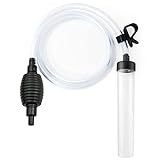
Overview: Laifoo’s 5-foot manual siphon keeps things refreshingly simple: a clear, kink-resistant hose, a sinkable gravel tube with built-in strainer, and a hand-squeeze bulb that starts flow in seconds—no mouth-priming required. At under fifteen bucks it’s aimed at beginners and nano-tank owners who want a no-frills weekly clean.
What Makes It Stand Out: The ultra-soft PVC hose stays limp even in cold water, so it coils neatly around rock work without spooking fish. The detachable screen inside the gravel tube is fine enough to trap poop yet snaps out for a quick rinse—something rarely seen on budget siphons.
Value for Money: You get three months of worry-free replacement for the price of two lattes. Replacement parts (hose, bulb, strainer) are sold cheaply by Laifoo, so the total cost of ownership stays low for years.
👍 Pros
- Tool-free assembly
- Gentle on fry
- Hose length suits tanks up to 40 gal
- Zero noise.
👎 Cons
- Flow rate is 100 % user-powered; deep 18-inch tanks need an extra pinch to restart if the tube lifts. Bulb valve can stick after salt-creep exposure unless rinsed
Bottom Line: If you keep fish in 10–50 gal and don’t mind a mini-arm workout, this is the most reliable “grab-and-go” siphon in the budget aisle. Cheaper electrics die; fancier manuals cost twice as much for the same job—save the cash for more fish.
7. lives Electric Aquarium Vacuum Gravel Cleaner, 32W 6 in 1 Multifunction Automatic Fish Tank Gravel Cleaner Vacuum for Wash Sand & Water Changer

Overview: Lives turns the classic “shake-and-siphon” chore into a plug-and-play power tool. A 32 W, 528 GPH pump sits in-tank while a six-function wand washes gravel, brushes ornaments, and pumps dirty water straight down the drain—no buckets, no huffing.
What Makes It Stand Out: Six snap-on heads (shovel, brush, narrow crevice, dual-size strainer) let you swap from sand-bed vacuuming to plant-leaf scrubbing mid-session. The external rocker switch keeps your hands dry, and the 2 m hose drains a 55 gal tank in under five minutes.
Value for Money: Fifty dollars feels steep until you tally saved water conditioner, towels, and Saturday morning minutes. Users report cutting weekly maintenance time by two-thirds—over a year that’s serious hobby-life balance.
👍 Pros
- Effortless on 30–200 gal
- Near-silent motor
- Adjustable tubes
- No batteries to recharge.
👎 Cons
- Motor housing is NOT waterproof; one dunk kills it. Power cord is only 1 m
- So outlet must be close. Fine sand can jam the impeller if flow is maxed
Bottom Line: For bigger setups or anyone with mobility issues, this electric package is a sanity-saver. Treat the control box like a hair-dryer and you’ll enjoy the fastest water-change rig short of Python’s full-faucet system.
8. EHEIM Quick Vac Pro Automatic Gravel Cleaner and Sludge Extractor- PetOverstock

Overview: Eheim’s Quick Vac Pro is the Roomba of gravel cleaners: a battery-powered, self-contained unit you simply plunge into the tank. It suctions detritus through an internal mesh cartridge and returns cleaned water—no hoses, no buckets, no sink required.
What Makes It Stand Out: Because it recycles the same water, you can spot-clean daily without altering water chemistry, stretching intervals between full changes. The sealed 3 ft depth rating makes it safe even in tall, filled display tanks.
Value for Money: At the same $50 price point as electric syphons, the Quick Vac saves on water treatment and time—handy in marine or Discus systems where large changes are stressful. Four AA batteries last roughly four 75 gal sessions; rechargeables drop that cost to pennies.
👍 Pros
- Totally cordless
- Ideal for glued display racks
- Media rinses in seconds
- Stores in a drawer.
👎 Cons
- Cartridge is small—expect two dumps per 40 gal. Fine mulm passes right back through
- So heavy waste tanks still need a traditional change. Replacement filters cost $8/3-pack
Bottom Line: Perfect for high-tech aquascapes where you want daily poop-patrol without draining. Don’t expect it to replace full water changes, but as a maintenance multiplier it’s unbeatable—especially for condo or office tanks far from a drain.
9. Luigi’s Fish Tank Cleaner – Turtle Tank Accessories – Gravel Vacuum for Aquarium – Hand Siphon Hose to Remove and Change Water or Sand in Minutes – Aquarium Cleaning Tools

Overview: Luigi’s neon-green hand pump is the smallest, cheapest cleaner of the bunch: 1.5 m hose, a one-way T-valve, and a gravel guard that doubles as a shrimp bodyguard. It collapses into a zip-lock, making it a favourite for dorm desks and betta bowls.
What Makes It Stand Out: The rigid intake sieve sits flat against the substrate so you can hover above Monte Carlo carpets without uprooting stems. Because flow is gentle, nano fish and shrimp ride out cleaning sessions unscathed—content creators love the “no casualty” reels.
Value for Money: Thirteen dollars beats even airline-tubing DIY rigs once you factor in the included valve and pump. No running costs except tank water.
👍 Pros
- One-hand operation
- No batteries
- Great handbag size
- Zero chance of electrocution.
👎 Cons
- Tiny bore means 5 L/min on a good squeeze—expect 10 min for a 20 gal. Hard plastic tubes don’t extend
- So anything deeper than 16 in requires gymnastics
Bottom Line: Ideal for pico and nano keepers who do frequent 20 % changes and prize simplicity over speed. If your tank is bigger than 30 gal, step up the hose diameter elsewhere; for a bedside 10 gal, this is all you’ll ever need.
10. Aquarium Siphon Pump Gravel Cleaner, Fish Tank Vacuum Gravels Cleaning Kit, Manual Water Changer with Air Push Button, Aquariums Sand Clean Set, Hose for Suck Manure Wash Sand

Overview: Seaoura’s bright-blue manual kit mixes the affordability of hand siphons with modular reach. Two extension tubes click together four ways, letting you tailor length from 15 to 35 inches while a dual-air-button head provides fast prime and micro-bubble-free flow.
What Makes It Stand Out: A built-in scraper blade on the intake crown lets you attack green spot algae on glass pane without swapping tools—nice for rimless tanks where magnet cleaners scratch. The gravel guard uses a fine nylon sock that slips off for machine washing.
Value for Money: At $22–23 it splits the cost difference between basic bulb siphons and entry electrics, yet gives you reach rivaling 6-foot hoses. Spare socks cost $6 for five, so upkeep stays trivial.
👍 Pros
- Snap-lock tubes don’t come loose mid-clean
- No electricity
- Works on 5–120 gal sizes
- Hose fits standard Python fittings if you upgrade later.
👎 Cons
- Plastic couplers can crack if overtightened; hot-water rinse recommended before first use to remove mould-release odour. Suction still depends on your forearm endurance
Bottom Line: If you want one siphon that can graduate from a 20 gal starter tank to a 4-foot 90 gal without rebuying gear, Seaoura’s kit is the sweet-spot purchase—robust, adaptable, and cheaper than a month of bottled water.
Why Gravel Cleaning Matters More Than You Think
Uneaten food, plant debris, and fish waste sink into the substrate where they slowly mineralize into nitrate, phosphate, and eventually hydrogen sulfide “gas pockets.” Regular siphoning removes those organics before they fuel algae blooms or crash pH. It also re-oxygenates the lower substrate layers, keeping anaerobic bacteria in check and root-feeding plants happy. In short, the gravel vacuum is your first-line nutrient-export tool—arguably more critical than the filter itself once a tank is cycled.
Matching Vacuum Type to Tank Size
Nano Tanks (≤10 gal)
Tiny footprints leave zero room for error; a full-size syphon can suck out three gallons before you blink. Look for wands under 2 cm diameter with adjustable air-bleed valves or USB micro-pumps that throttle down to 30 L/h.
Small to Medium Tanks (10–40 gal)
The hobby’s sweet spot. A manual shaker-starter syphon with 1–1.5 in diameter hose is still common, but battery models that clip onto the rim spare you the “mouth-full-of-fish-water” moment and let you pause flow mid-task.
Large Displays (40–125 gal)
Water volume gets heavy—literally. Faucet-powered venturi cleaners can discharge 6–8 L/min straight down the drain, cutting 30 % water changes to ten minutes. Ensure your tap has 2–3 bar pressure and install dual check-valves to prevent municipal back-siphon.
Monster & Pond Systems (>125 gal)
Multiple depth zones mean telescoping rigid tubes (24–48 in) and impeller-driven pond vacs with 1500 L/h lift. Look for mesh pre-filters so you don’t decimate daphnia clouds or fry banks while hoovering mulm.
Manual vs. Battery vs. Faucet-Powered Systems
Manual syphons cost pennies, never need charging, and break down to a glorified hose—perfect travel kit. Battery units trade unlimited runtime for torque; lithium packs below 2000 mAh stall on coarse pea-gravel hills. Faucet-powered units marry unlimited suction to unlimited discharge, but they waste water and run your utility bill unless you throttle aggressively.
Flow Control: The Feature Most Beginners Overlook
A thumb-press valve on the hose is fine—until you flush carbon dust all over the water column because you didn’t expect the substrate to be that light. True micro-adjust dials, or stepped nozzles machined into the wand, deliver reproducible flow rates so you can dial “just enough” to lift detritus and no more.
Nozzle Design & Substrate Compatibility
Slotted “shrimp-safe” guards keep cherry fry in the tank while still inhaling 1 mm muck balls. Coarse 4 mm openings work for river stones but miss fine dust; dual-density venturis combine both, swappable tool-free. Pointed crevice tips sneak under driftwood and rock ledges without up-ending the entire hardscape.
Anti-Clog & Debris Separation Technology
Inline swirl chambers or coarse foam inserts spin heavier particles sideways so only dissolved organics reach the hose. Result: fewer mid-siphon clogs when you hit that inevitable cat-food-sized pleco pellet. Clear chambers act as a sight-glass—when mulm density plateaus, you know you’ve cleaned enough.
Hose Length, Diameter & Drain Options
Friction loss is real: every extra meter of 12 mm hose can cut flow 8 % at 1000 L/h. If your laundry sink sits three rooms away, upgrade to 16 mm tubing or split the run with a pump-assisted canister. Keep at least one transparent section to spot blockages before they stall the head.
Preservation of Beneficial Bacteria
Substrate biofilms cling to surfaces; aggressive blasts strip them. Gentle, intermittent pulses—achieved with a quick thumb-off/on technique or the vacuum’s pulse mode—lift detritus while leaving bacterial slime intact. Target a 20–30 % surface clean per week, not the Sahara-desert approach.
Ease of Priming & Water-Change Integration
Self-priming bellows, squeeze bulbs, or one-way flutter valves eliminate “the shake” and spare your wrists. Models with built-in water-change graders (metered dispensing buckets) guarantee you replace exactly what you remove—handy for brackish tanks where salinity creep is a risk.
Noise & Vibration Considerations
Rubber-isolated impeller housings shave 6–8 dB off typical pond-vac whine—enough to watch TV in the same room. If bedrooms sit above the tank stand, choose DC rather than AC pumps; sine-wave controllers eliminate the 60 Hz hum that travels through floor joists.
Build Quality & Material Safety
Look for REACH- or ROHS-certified plastics stamped “fish safe.” Beware brass faucet connectors: many contain >2 % lead. Marine-grade silicone gaskets stay supple in brackish; cheap nitrile can swell and seize in months. Tempered glass sight chambers handle occasional bangs against rockwork without shattering.
Maintenance & Spare Part Availability
Impellers wear; o-rings stretch. Models with screw-off motor pods and standardized seals save you from replacing the entire unit when a $2 ring fails. Check user forums for parts diagrams—if you can’t find a replacement diaphragm now, you won’t in three years either.
Budgeting: Initial Outlay vs. Long-Term Savings
A $15 manual syphon plus $10 worth of de-chlorinator each year may look cheaper than a $80 battery vac—until you factor in your hourly wage wrestling buckets every Saturday. For tanks over 50 gal, a mid-range faucet model typically pays for itself in six months through water-change time saved and reduced spill damage.
Safety & Flood-Prevention Tips
Place a cheap Wi-Fi leak sensor under the stand; if the discharge hose slips out of the sink the alarm kills smart-plugs powering pumps. Always use a vacuum break (air gap) where hose meets drain, and secure connections with stainless hose clamps—not plastic zip-ties that fatigue under warm water.
Eco-Friendly Practices & Water Reuse
Collect discharge in a rain-barrel; once de-chlorinated it’s perfect for garden irrigation—fish manure is an excellent orchid fertilizer. Running the final rinse through a diatom filter lets you reclaim 30-40 % for the next salt mix, cutting marine salt costs and city water strain.
Troubleshooting Common User Errors
- Sudden temp shock: match tap water to tank within 1 °C; mix valves help.
- Cloudy water post-clean: you stirred the bacterial bio-layer; dose a flocculant and run a polishing pad two hours.
- Repeated clogs: nozzle is too wide for fine sand—swap to a slotted guard or lower flow.
Frequently Asked Questions
-
How often should I vacuum my substrate?
Weekly partial cleans (20 % surface area) beat monthly deep excavations; stability is key. -
Can a gravel vacuum harm plant roots?
Gentle pulses won’t uproot established plants; angle the nozzle parallel to the substrate and avoid jamming into the crown. -
Do battery vacuums lose suction as the charge drains?
Quality models use DC buck converters to maintain torque until the pack is 90 % depleted—cheap motors taper gradually. -
Is it safe to use a faucet-powered cleaner on a septic system?
Yes, but install a high-flow drain saddle to avoid back-pressure, and never use hot water which kills tank bacteria. -
What hose diameter is best for fine sand?
Go narrow (≤10 mm) and low flow; larger hoses generate venturi suction strong enough to lift entire sand beds. -
How can I clean the vacuum itself between tanks?
Rinse with 1:20 household bleach, de-chlorinate, then air-dry; disassemble impeller pods to prevent biofilm cross-contamination. -
Will vacuuming disrupt my cycling process?
Minimal surface passes remove mulm, not filter bacteria; avoid deep substrate cores until ammonia reads zero. -
Why does my water smell like rotten eggs after vacuuming?
You likely released trapped hydrogen sulfide pockets; increase circulation and vacuum more frequently to prevent anaerobic spots. -
Can I connect a gravel vacuum to a canister filter inlet?
Most canisters rely on sealed siphons—introducing air via a vac line can stall prime. Use an inline pump instead. -
Is a longer wand always better for tall tanks?
Not necessarily; beyond 24 in you need telescoping rigidity to avoid wrist fatigue, and impeller head pressure drops with height—match pump specs to actual water depth.