Keeping your aquarium squeaky-clean used to mean hauling buckets, scrubbing algae until your forearms screamed, and accidentally sucking up half the plants in the process. Today, electric aquarium vacuum cleaners have flipped the script—turning marathon gravel-vac sessions into a 5-minute lounge break while the battery-powered unit does the dirty work. Whether you’re nurturing a high-tech reef or a peaceful Betta oasis, choosing the right electric vac can mean the difference between crystal-clear perfection and daily frustration.
But not every motorized “fish-safe sucker” is worth the money. Between water-change percentages, micron filters, wattage limits, rapid-charge hubs, and app integration, 2025’s market is flooded with features that sound great in product blurbs yet wilt under real-world scrutiny. This guide breaks down what matters most—motor efficiency, lifespan, adaptability, safety tech, and user-friendly design—so you can spot genuine innovation from flashy marketing fluff before you ever reach the checkout page.
Top 10 Electric Aquarium Vacuum Cleaner
Detailed Product Reviews
1. UPETTOOLS Aquarium Gravel Cleaner – Electric Automatic Removable Vacuum Water Changer Sand Algae Cleaner Filter Changer 110V/28W

Overview: The UPETTOOLS Aquarium Gravel Cleaner is a 28-watt electric vacuum that promises six-in-one functionality for effortless tank maintenance.
What Makes It Stand Out: A 1700 L/H pump can drain a 180-gallon tank in 30 minutes, and the telescopic tube spans 23.6–37.7 inches, fitting almost any home aquarium. The brand’s 3-year warranty plus 24/7 support reassures cautious buyers.
Value for Money: At $35.99, it delivers commercial-grade power and a long warranty without premium pricing, placing it near the bottom of the electric-cleaner cost curve.
Strengths and Weaknesses: Pros: high flow rate, universal depth fit, lengthy warranty. Cons: Electric switch is not waterproof, so extra care is needed during operation.
Bottom Line: If you manage mid-to-large tanks and demand power backed by solid after-sales support, this budget-friendly juggernaut is a must-have.
2. AQQA Electric Aquarium Gravel Cleaner, 6 in 1 Automatic Fish Tank Cleaning Tools Gravel Vacuum for Aquarium, Suitable for Change Water Wash Sand Water Filter and Water Circulation (320GPH, 20W)
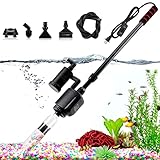
Overview: The AQQA Electric Cleaner is a compact 20-watt, 320GPH unit aimed at casual aquarists seeking an all-rounder kit under $32.
What Makes It Stand Out: “Take-it-out-of-the-box” assembly plus a sponge-filter cup that doubles as a gentle turtle shower make the cleaner unusually beginner-friendly; the parts list is generous for the price.
Value for Money: At $31.49, you receive the pump plus seven accessories—nearly half the cost per component of most kits—making it an entry bargain that still feels professional.
Strengths and Weaknesses: Pros: affordable, rich accessory bundle, low wattage keeps noise down. Cons: fixed-length handle limits very deep tanks, and the 320GPH flow trails harder-hitting rivals.
Bottom Line: Perfect starter set for tanks up to 40 inches high where rock-bottom cost and simplicity trump raw power.
3. Suness Electric Aquarium Vacuum Gravel Cleaner: 36W Fish Tank Cleaner Vacuum with Strong Suction for Water Change Wash Sand Algae Cleaner Water Shower and Water Circulation, Timed Off

Overview: The Suness 36-watt flagship is the first electric gravel vac in this roundup to add a timed auto-shut-off and 3-stage filtration—activated carbon, bio-balls and sponge—sporting a premium $69.99 price.
What Makes It Stand Out: Three power tiers (19–36W) plus 10/30/60-minute timers make missed flood disasters nearly impossible, while 99% impurity removal claims are backed by washable reusable media.
Value for Money: Double most competitors, yet its smart features and comprehensive package—1.5 m hose, telescopic 15-cm tube, eight heads—offer legitimate upgrade value for diligence-free maintenance.
Strengths and Weaknesses: Pros: timer safety, true multi-stage filtration, quiet variable motor. Cons: highest price; external switch must stay dry, mandating careful handling.
Bottom Line: Buy this only if you prize automation and multi-stage polishing; serious aquarists with sensitive stock will find the premium justified.
4. lives Electric Aquarium Vacuum Gravel Cleaner, 32W 6 in 1 Multifunction Automatic Fish Tank Gravel Cleaner Vacuum for Wash Sand & Water Changer

Overview: The lives 32-watt cleaner combines robust 528 GPH suction with a 2-meter hose in a mid-tier $49.99 package designed for tanks from 10–200 gallons.
What Makes It Stand Out: The kit drains one gallon every 30 seconds—double the speed of manual siphons—while the strong flow stays whisper-quiet; tool-free assembly is a genuine time saver.
Value for Money: A silver-spot between budget and premium, the price delivers speed, reach, and quiet operation without stepping into Suness territory.
Strengths and Weaknesses: Pros: rapid water changes, generous 2-m hose, quiet 32 W motor. Cons: External switch not waterproof, and plastic accessory threads feel less durable over years of use.
Bottom Line: For larger aquariums where midrange wattage and proven speed matter more than bells and whistles, lives hits the sweet spot of price and performance.
5. hygger 360GPH Electric Aquarium Gravel Cleaner, 5 in 1 Automatic Fish Tank Cleaning Tool Set Vacuum Water Changer Sand Washer Filter Siphon Adjustable Length 15W
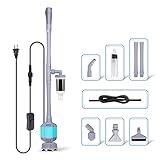
Overview: hygger packs five core functions into a 15-watt, 360 GPH frame, touting UL-certified internals while keeping the price at a competitive $35.99.
What Makes It Stand Out: It starts pumping at only 2 inches of water and can drop as low as 0.3 inches—excellent for shallow breeding trays or turtle tanks—while four snap-fit extension tubes span 11.4–40.5 inches for versatility.
Value for Money: Full-array filtration plus UL certification at the same cost as budget pumps delivers safety and flexibility rarely matched in its class.
Strengths and Weaknesses: Pros: ultra-low starting level, energy-efficient UL motor, included brush and duckbill heads. Cons: 15 W motor is the weakest here; very dirty substrates may need multiple slow passes.
Bottom Line: Ideal keeper for shallow, sensitive tanks or breeders who prioritize safety, frugal wattage, and low-profile suction over brute force.
6. AQQA Aquarium Gravel Cleaner, 6-in-1 Electric Fish Tanks Gravel Vacuum Cleaner Set for Remove Dirt, Change Water, Wash Sand, Water Shower, Water Circulation (20W, 320GPH)

Overview: The AQQA 6-in-1 Electric Gravel Cleaner is an entry-level cleaning station that promises water changes, sand washing, debris removal, water filtration, showering and circulation—essentially a multitool aquarium kit for under forty bucks.
What Makes It Stand Out: The 38.4″ adjustable suction tube covers a huge 13.7″–47.2″ tank height range, making it one of the few budget cleaners that truly handles deep display tanks right out of the box.
Value for Money: At $35.99 the kit slashes the need for separate siphon hoses, buckets and manual hand pumps; for new aquarists on a budget it pays for itself within a month of use.
Strengths and Weaknesses: + Strong 320 GPH flow clears debris fast, 6-in-1 versatility, tool-free disassembly, effective mesh gravel guard. – 20 W motor must stay 100 % submerged under the intake, or suction collapses; the external switch repeatedly mentioned as not water-resistant.
Bottom Line: If you own one mid-size or deep tank and hate juggling half a dozen cleaning gadgets, the AQQA is the “set-and-forget” starter that does almost everything but doesn’t love shallow setups.
7. FOUSIUTIM Electric Aquarium Gravel Cleaner, 6-in-1 Automatic Fish Tank Cleaner Vacuum – 32W 530GPH Powerful Gravel Vacuum for Aquarium, Sand Washer (Blue with Temperature Sticker)

Overview: FOUSIUTIM markets its 32-W, 530-GPH gravel vacuum as the heavy-duty big brother to cheaper cleaners, bundling multi-attachment convenience with a conspicuous blue body and bonus temperature sticker.
What Makes It Stand Out: Raw power—530 GPH and 32 W specs stretch across 32-inch tanks while still staying quieter than many comparators thanks to an IP68-sealed pump.
Value for Money: At $49.99 the upcharge over 20 W models is modest given faster water changes and bigger detritus pickup, and the 30-day return window removes most buyer risk.
Strengths and Weaknesses: + Blistering flow, sturdy telescopic pole, reusable coarse sponge filter, quiet submerged motor. – External switch is not waterproof (again!), some users report tube threading loosens if over-tightened.
Bottom Line: Upgrade pick for anyone who’s moved past nano tanks: it’s faster, stronger, and still safe, provided you keep the switch bone-dry.
8. Fluval 11077 ProVac Powered Aquarium Gravel Cleaner – Aquarium Gravel Vacuum

Overview: Fluval’s ProVac is the premium plug-and-play option, ditching DIY tube hacking for a purpose-built, high-quality tool that looks and feels like it belongs in a professional fish room.
What Makes It Stand Out: Dual-speed motor with a clever “pause” detent lets trapped gravel drop instantly—no more frantic shaking—and built-in LED spotlight turns night-time digging into a precise, no-mess job.
Value for Money: At $52.69 it’s priced above generic brands, but ergonomic handle, durable polycarbonate and replaceable dual-density pads make the cost per change lower over the years.
Strengths and Weaknesses: + Purpose-built quality, LED cleaning light, gravel guard plus pad combo, rechargeable seal-free. – Hose for water change sold separately, max reach shy of the deeper 40″ tanks without extension parts.
Bottom Line: For owners of 20–36″ community tanks, the ProVac is the closest thing to owning an aquarium Roomba—fast, frustration-free and built to last if you budget the extra hose.
9. AQQA Aquarium Gravel Cleaner Kit, 6 in 1 Electric Fish Tank Vacuum Cleaning Tools Water Changer, Multifunction Wash Sand Filter Water Circulation 20W 320GPH 110V

Overview: Essentially a streamlined re-package of Product 6. AQQA drops the wattage to 20 W but loads the box with six nozzle combinations for laser-focused spot cleaning.
What Makes It Stand Out: Diver-style accessory tray—duckbill, corner nozzle, 360° brush—lets you scrub walls, skim sand corners or rinse turtles without returning to the cabinet for another tool.
Value for Money: At $32.39 it’s the best dollar-per-nozzle value on the shelf and fractionally cheaper than Product 6, ideal for budget hobbyists who obsess over every crevice.
Strengths and Weaknesses: + Huge accessory set, 316-grade impeller shaft for near-silent operation, starts at 2″ water depth. – Same non-waterproof switch and short power cord; assembly/disassembly takes minutes each cleaning cycle.
Bottom Line: Pick it over Product 6 ONLY if those specialized nozzles matter more to you than a longer main tube—otherwise stick with the deeper-reaching sibling.
10. AQQA DC 36W Electric Aquarium Vacuum Gravel Cleaner 6-in-1 Multifunctional Fish Tank Cleaning Kit for Remove Dirt, Change Water, Wash Sand, Turtle Water Shower, Water Circulation with Adjustable Power

Overview: AQQA’s 36 W flagship aims to outclass the whole lineup with continuous 15–36 W DC stepless control and a Teutonic 600 GPH ceiling, plus an ample 37.4″ adjustable pole.
What Makes It Stand Out: External dial lets you dial suction from infant fry tank gentle to monster-seafood-hose brutal, while 110-240 V global PSUs make future tank moves or country swaps painless.
Value for Money: At $49.99 it’s only marginally pricier than mid-wattage models yet out-pumps everything under $60; for multi-tank folks one tool replaces three cheaper units.
Strengths and Weaknesses: + Variable wattage & flow, generous pole range, quiet ceramic rotor, 2.4 m controller cord for dry power strips, simple rinse-clean. – 36 W peak draws extra current and must stay fully submerged; large wall-wart power brick can clutter aquarium stands.
Bottom Line: If your tanks range from 12″ planted cube to 200-gallon river manifold, the 36 W AQQA is the single adapter you’ll ever need—powerful, flexible and globally friendly.
Why Manual Siphons Are Fading Into Obsolescence
Hand-pumping gravel cleaners still linger in big-box stores, yet veterans know the drawbacks: the dreaded mouthful of aquarium water at start-up, inconsistent drainage rates, and the need for enough height drop to keep flow going—an impossible ask in apartments or small tanks. Electric vacuum cleaners solve these issues at a stroke, offering one-handed control, true self-priming, and sealed circuits that never expose you (or your fish) to contaminated backflow.
Core Anatomy of an Electric Aquarium Vacuum Cleaner
Motor Assembly & Hydrodynamic Design
Brushless motors are quickly becoming the gold standard, promising quieter operation and 50–80 % longer service life than brushed alternatives. Internally, the volute casing profiles have shifted from straight vane to mixed-flow geometry in order to maintain suction while minimizing detritus pulverization—critical when you’re cleaning delicate plant substrates or fragile coral sand.
Impeller & Shaft Sealing Technology
Look for magnetic drive couplings that allow the impeller to spin in complete isolation from the main housing. Dropping redundant shaft seals eliminates the biggest failure point: water intrusion that fries the motor and sends rust into the tank. The sealed magnetic rotor also reduces electrical leakage by an order of magnitude, a must-have for sensitive reef setups.
Intake Grate & Ultrasonic Debris Sensor
Newest-gen models tweak the grate aperture to just 2 mm, letting fine mulm pass while barring baby fish and delicate shrimp fry. Some upscale editions even embed an ultrasonic transducer that calculates debris density and throttles suction on the fly—think “cruise control” for your cleaning path.
Suction Power vs. Aquatic Life Safety
High-PASCAL suction is useless if your fancy loaches end up clinging to the intake screen every session. The most refined electric aquarium vacs now employ dual-stage PID controllers that flatten suction spikes on start-up, plus “soft-start” ramps that crescendo from zero to max over two seconds—plenty of time for timid fish to flee to cover. Over-current protection throws the safety relay if the impeller locks, preventing rotor stall injuries like fin shredding or scale damage.
Controllable Flow Rates: Why Every Tank Is Different
A 300-liter Discus biotope crammed with mopani wood requires dramatically gentler flow than a bare-bottom Malawi show tank. Variable-speed sliders and app-controlled presets let you fine-tune for plant dust, snail eggs, or stubborn cyanobacteria films. Pro-grade units provide flow charts matching pump RPM to tank volume brackets—a feature worth its weight in gold when you’re walking the line between efficient cleaning and substrate erosion.
Filtration Media Configurations Explained
Mechanical Sponges & Micron Socks
Larger debris gets snared in 20–200 μm polyester or reticulated foams. Shallow-gradient cones (45°) resist compaction better than cylindrical cartridges, staying clog-free for longer.
Chemical & Biological Cartridges
While primarily a gravel vac, better machines integrate 10 g sachets of mixed resin—ion exchange plus organics absorbers—in a snap-in capsule. Bio-ceramic inserts promote nitrifying bacteria colonies, turning the vacuum head into a movable biofilter during cleaning runs.
Battery Chemistry: Lithium vs. Polymer vs. USB-PD Powerbanks
Long gone are the Ni-Cd bricks of yesteryear. 2025 models embrace high-density 21700 Li-ion cells offering 50 Whats at only 350 g mass—great for cordless convenience without sacrificing suction. Polymer packs shave grams further but risk swelling under heat, so savvy brands insert thermal throttling ICs and aluminum heat spreaders. USB-PD 3.1 compatibility means you can top up from a laptop charger at 45 W while prepping ferts—no specialty bricks cluttering the shelf.
Nozzle Versatility: Flat, Crevice, Brush, and Pixelated Tips
Flat Nozzles for Broad Gravel beds
The 90 mm wide flat head rides just above substrate preventing sand storming while still nabbing detritus from between grain crevices.
Crevice & Brush Attachments for Aquascaping Roots
These pinpoint rifles direct suction into tight nooks under driftwood bases without uprooting micro sword carpets.
Pixelated Multi-Jet Tips
An indie lab breakthrough: 9 micro-jets fire counter-flow pulses to lift mulm out of Staurogyne repens mats before the central vortex sucks it away. The outcome? Spotless plants with zero leaf shredding.
Tank Size Compatibility: Nano, Standard, and Monster Tanks
Smaller nano models prime within 60 ml of water—great for 10 L shrimp cubes that would otherwise drain 80 % of volume if done manually. Conversely, rigs rated for 1000 L+ often ship with detachable extension wands and reinforced tubing able to handle 18 mm OD without kinking under the weight of 20 ft runs across living-room floors.
Smart Integration: App Control and Real-Time Parameter Monitoring
Modern ecosystems are as digital as they are aquatic. Bluetooth mesh connects the vacuum to aquarium controllers like GHL, Hydros, or your smartphone. Three-tap sequences set water level targets, auto-fill shutoffs, and even push-log nitrates trend data into cloud dashboards. Firmware updates roll out OTA (over-the-air) to patch motor drive curves, ensuring your six-month-old unit keeps pace with tomorrow’s data standards.
Ease-of-Maintenance Design: Tool-Free Disassembly & Self-Cleaning Nozzles
Quick-lock bayonets release the motor pod, filter basket, and nozzle trio in under 10 seconds. Silicon O-rings are chemically-etched with nano-texture to reduce biofilm glue and pop out for calcium build-up removal without tools. Self-cleaning cycles reverse the impeller for 5 seconds pre- and post-run, expelling flakes from mesh screens—cutting manual upkeep by 70 %.
Noise & Vibration Dampening Considerations
Sound dampening foams line the housing, transforming the typical 55 dB whirr into a 38 dB murmur quieter than most air pumps. High-precision CNC-balanced rotors are magnetically levitated via dual-bearing sleeves, eliminating gyroscopic wobble that used to rattle glass panes and unglued montipora frags.
Warranty, Certification & Safety Standards
Top brands now match their cordless drills—3-year base plus a 40 % buy-in 2-year extension. Submersion IPX8 certification is required before a model earns “aquarium-grade.” Further flair includes CE, UL, FCC, plus RoHS-3 conformity certificates proving zero PVC phthalates in tubing marketed for reptile paludariums that share water circuits.
Sustainability & Eco-Friendly Manufacturing Trends
Case plastics pivot to post-consumer PC-ABS blends that are 45 % recycled without sacrificing UV resistance. The accompanying filter foams use mono-material polyolefin compositions so shredders can recycle without landfill residue. Renewable kelp-based flocculants replace traditional alum conditioners, trimming chemical footprints one clean-up at a time.
Budget vs. Premium Tiers: Where Extra Dollars Really Matter
At the entry tier ($70–$120) expect 20-minute runtimes, fixed-speed motors, and simple clamp-on flow valves. Mid-tier ($130–$220) opens the door to variable speed triggers, USB-C batteries, and modular filtration pods. Premium ($250+) grants joystick-grade throttle control, real-time turbidity readings via in-line laser diffraction, and exchangeable impeller diameters able to swap from 6 mm fines cleaning to 12 mm snail shell pickup in 30 seconds flat.
Frequently Asked Questions
1. Can I use an electric aquarium vacuum on a planted tank without uprooting carpet grasses?
Absolutely—set the RPM to the lowest reproducible flow and employ the soft-start feature. Pixelated or brush-tipped nozzles further reduce substrate disturbance.
2. What’s the typical battery life on a single charge for nano versus large models?
Nano models deliver 25–35 minutes at eco setting, while high-capacity large-tank units land around 45–60 minutes. Li-ion degradation is minimal; expect 500 full cycles before capacity drops below 80 %.
3. Does the filter outlet need to remain above the tank waterline to prime?
No. Most electric vacuums self-prime due to the integrated impeller; gravity-fed limitations are strictly an old-school siphon artifact.
4. Are these devices safe for sensitive invertebrates like Caridina shrimp fry?
Yes, thanks to 2 mm intake grates and impeller PID torque curves. We still recommend running the vacuum on the lowest setting if your tank is bursting with newly hatched shrimplets.
5. How often should I replace the mechanical filter sponge?
Rinse weekly in dechlorinated water and replace every 6–12 months, depending on bioload. Inspect for tearing or permanent discoloration after intensive cleaning sessions.
6. Will the strong magnet coupling interfere with aquarium electronics?
Modern ferrite rings are precisely balanced and RF-shielded; no impact on heaters, probes, or Wi-Fi controllers inside standard glass thicknesses up to 15 mm.
7. Can I swap chemical filter cartridges while the pump is running?
Snap-lock holders allow hot-swaps mid-session without shutdown. Just pause for two seconds to avoid burping water mid-air.
8. Is it normal for the vacuum to sink after a few minutes?
Cheaper models without sealed buoyancy compartments may nose-dive. Premium versions use Stryro-ABS composite floats to remain neutrally buoyant regardless of battery levels.
9. Do electric vacuums reduce the need for water changes?
They only replace detritus removal—water changes still replenish trace minerals and buffer parameters. Think of the vacuum as your gravel vacuum assistant, not a full replacement.
10. How does firmware updating work without Wi-Fi?
Bluetooth Low Energy handles the handshake, email-generated bin files push via mobile app, and the vacuum shuts off automatically post-flash—no home Wi-Fi required.