Your feline friend’s dinner-time posture is probably the last thing on your mind when you’re browsing the cat aisle—until you notice the post-meal coughs, the scattered kibble, or the regurgitated pile on the carpet. Elevated, or “raised,” cat food bowls have quietly moved from veterinary rehab centers to mainstream pet homes because they solve a surprisingly long list of whisker- and stomach-related woes. In this guide you’ll learn exactly how height, angle, and bowl geometry influence digestion, why 2025’s bowl designs are radically different from the “just-stick-it-on-a-stand” models of 2020, and which features deserve your dollars—no matter which brand you ultimately choose.
Top 10 Raised Cat Food Bowls
Detailed Product Reviews
1. Upgraded Elevated Cat Bowls with Food Mat,15°Tilted Stand Anti Vomiting Raised Cat Dishes for Food and Water,2 Stainless Steel Bowls for Cats and Puppy

Overview:
The Upgraded Elevated Cat Bowls bundle delivers a mini feeding station: two shallow, whisker-friendly stainless-steel dishes sit in a 15°-tilted bamboo stand that rests on an oversized silicone mat. Together they promise cleaner floors, easier swallowing, and a more relaxed diner for cats or toy-breed pups.
What Makes It Stand Out:
Most budget sets skip a mat; here an 18.9″×11.8″ food-grade silicone mat is part of the base price. The shallow 1.2″ bowls combat whisker fatigue while the tilted platform adds anti-vomit benefits usually seen in $30+ feeders.
Value for Money:
At $16.99 you’re effectively paying $8.50 per stainless bowl and getting the wooden rack and giant mat free—cheaper than buying the components separately.
👍 Pros
- Skid-proof mat truly contains kibble chaos; bowls pop out for dishwasher cleaning; attractive natural wood look.
👎 Cons
- Lightweight stand can slide on slick floors; bamboo base must be hand-wiped
- Can swell if soaked; 5-oz capacity may require refills for multi-cat homes
Bottom Line:
A thoughtful, all-in-one kit for single-cat guardians who want less mess and gentler mealtimes without spending premium dollars.
2. Kitty City Raised Cat Ear Bowls, Small Bowls 2pk (Modern)

Overview:
Kitty City’s Raised Cat Ear Bowls are a pair of 6.5-oz minimalist dishes perched on cute ear-shaped pedestals. Marketed as a “starter elevated set,” they lift food just enough to ease neck strain while keeping the silhouette low and living-room friendly.
What Makes It Stand Out:
The ear-shaped cut-outs create an adorable cat-face profile that photographs well for social media. The oval openings are intentionally wide, preventing whisker stress without resorting to ultra-shallow sides that spill easily.
Value for Money:
$9.99 for two pedestals is about the price of a single replacement bowl from premium brands—perfect if you want to test elevated feeding without a big buy-in.
👍 Pros
- Top-rack dishwasher safe; space-saving footprint fits small apartments; cute neutral gray & white colors suit most décor.
👎 Cons
- Thin plastic scuffs and may harbor chin acne in sensitive cats; 2″ lift helps only mildly with digestion; no non-slip base
- So energetic eaters can push them across the floor
Bottom Line:
An inexpensive, Instagram-ready upgrade from floor bowls—best for casual eaters and style-first pet parents rather than serial vomiters.
3. Kitty City Raised Cat Bowls, Small Bowl 2pk (Pastel)
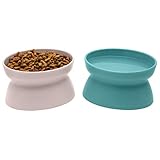
Overview:
Functionally identical to Product 2, Kitty City’s Pastel set swaps the monochrome scheme for soft teal and blush pink, adding a playful pop to kitchens or nurseries. Each 6.5-oz dish sits 4″ high, giving kittens and average-size cats a modest ergonomic boost.
What Makes It Stand Out:
Pastel pet gear is still rare at big-box stores; this set lets owners coordinate with trendy home palettes without paying boutique prices.
Value for Money:
$8.70 makes it the cheapest reviewed option—less than a fancy coffee and still dishwasher safe.
👍 Pros
- Feather-light for travel; rounded interior corners reduce food trapping; fun colors encourage kids to participate in feeding chores.
👎 Cons
- Pastel plastic may stain with oily fish foods; same slipping issue as the modern version; limited height does little for arthritis-plagued seniors
Bottom Line:
A bargain decorative accent that mildly improves posture—grab it for kittens, foster rooms, or color-themed décor, but upgrade if your cat refluxes regularly.
4. Necoichi Raised Cat Food Bowl – Ceramic Elevated Cat Bowl for Whisker & Neck Fatigue, Dishwasher Microwave Safe – Non-Slip & Anti Vomiting Ergonomic Design (Cats, Extra Wide)

Overview:
Necoichi’s Raised Ceramic Bowl is the Lexus of single-cat dishes: porcelain, wide-mouthed, and perched on sturdy 2.75″ legs. Designed for flat-faced Persians and messy eaters, its broad 6.1″ surface keeps kibble centered while the elevation reduces neck bend and post-meal puke.
What Makes It Stand Out:
The removable silicone ring around the base acts like built-in Velcro—no sliding, no tipping, yet peels off for microwave or dishwasher cleaning. Porcelain is non-porous and meets human dinnerware safety standards, eliminating plastic chin-acne worries.
Value for Money:
$19.99 for one bowl sounds steep until you factor in vet-grade material, anti-slip engineering, and the fact that porcelain outlasts cheaper plastics that cloud and scratch.
👍 Pros
- Genuinely tip-proof; elegant enough for dinner parties; microwave safe for warmed renal diets; wide brim prevents whisker contact.
👎 Cons
- Single bowl means buying two for food/water; 1.2 lb heft isn’t travel friendly; chip-able if slammed on tile
Bottom Line:
If you have one special cat (or a regurgitation-prone flat-face), this is the most stable, hygienic dish you can buy without going full bistro-feeder.
5. Elevated Tilted Cat Bowls for Indoor Cats,Raised Ceramic Cat Bowl Elevated 15°,Pet Feeding Bowls for Food and Water Anti Vomiting Bowl(Double Ceramics and Tilt Shelf) Suitable

Overview:
This duo of 5″ ceramic bowls nests on a 15°-angled iron rack, pairing the cleanliness of porcelain with the trendy tilted stance vets recommend for acid-prone cats. Sold as a complete double set, it invites owners to serve food and water side-by-side while keeping the footprint apartment-small.
What Makes It Stand Out:
You receive two full-depth ceramic bowls plus a metal stand for $13.99—cheaper than many single ceramic dishes alone. The 15° slope hits the sweet spot referenced in veterinary studies for reducing regurgitation.
Value for Money:
Essentially $7 per dishwasher-safe ceramic bowl with a free tilted shelf; unbeatable if you need matching water and feeding stations.
👍 Pros
- Rack has rubber feet to protect floors; smooth glaze rinses spotless in seconds; 2.76″ depth holds 8 oz—great for wet-food portions.
👎 Cons
- Metal frame can rust if water drips and left to sit; bowls sit loosely
- So exuberant cats might paw one out; rack color options are limited
Bottom Line:
An affordable, vet-aligned upgrade for households transitioning from floor bowls to something kinder on feline stomachs—just dry the frame after cleaning and you’re set.
6. Elevated Cat Bowls with 3 Stainless Steel Bowls | 10° Tilted Anti-Vomiting Raised Cat Food Bowl for Small Cats and Puppies Pet Bowl with Stand

Overview: A three-bowl feeding station crafted from stainless steel and bamboo that promises cleaner floors, happier whiskers, and calmer tummies thanks to a gentle 10° tilt.
What Makes It Stand Out: The triple-bowl carousel is the star—rotate it and you’ve got wet food, dry food, and water in one footprint. The 10° angle was chosen after the maker tested steeper slopes that still let kibble bounce out, so it’s a data-driven tilt rather than marketing fluff.
Value for Money: At $27 you’re effectively paying $9 per heavy-gauge stainless bowl plus a furniture-grade bamboo stand. Comparable single tilted bowls sell for $15-$20 each, so the set punches well above its weight.
Strengths and Weaknesses: Bowls click in securely, are dishwasher-safe, and the stand stays put on tile. On the flip side, the 18 oz capacity is overkill for kittens, and the wood base can swell if you leave it outside in the rain.
Bottom Line: If you feed multiple cats or like offering variety without cluttering the floor, this is the one-stop station to buy.
7. NABOKIO Tilted Cat Food Bowl – Whisker Friendly, Anti Vomiting, Slanted, Cat Bowl, Blue

Overview: A sky-blue, whisker-friendly saucer that elevates your cat’s kibble just enough to cut down on post-meal puke without hogging counter space.
What Makes It Stand Out: The bowl’s 12 cm-wide, 3 cm-deep profile is basically a cat-friendly plate—no walls to tickle sensitive whiskers—while the subtle 5° tilt and rubber-ringed base keep crunchies centered even when enthusiastic paws hit the mat.
Value for Money: Ten bucks is impulse-buy territory, yet you’re getting thickened, BPA-free ABS that survives dishwasher cycles and the occasional kick across the kitchen.
Strengths and Weaknesses: Cleaning takes seconds, and the low rim is perfect for flat-faced Persians. The downside? Capacity is limited to about 200 ml, so water refills are frequent, and the plastic can pick up tomato stains if you feed wet food.
Bottom Line: Ideal starter dish for single-cat apartments; upgrade only if you need more volume or a heavier base.
8. LoeJan Elevated Cat Food Bowl, 5 Oz Ceramic Raised and Tilted Water Bowl, Anti Vomiting and Protect Pets’ Spines Dishes for Small Dog, Fat Faced Cat, Kitten (White, 1 Pack)

Overview: A petite 5 oz ceramic cup that perches on a built-in pedestal, angling dinner toward your cat’s mouth to ease arthritis and cut vomiting episodes.
What Makes It Stand Out: Microwave-safe glaze means you can warm kidney-care food right in the bowl, and the 3-inch height is calibrated for elderly cats who can’t crouch without pain.
Value for Money: Ten dollars buys veterinary-recommended posture improvement and a dish that will never rust or leach chemicals—cheaper than a single anti-nausea pill.
👎 Cons
- Capacity is tiny
- Multi-cat households will need several
- And the base isn’t non-slip—add a silicone mat
Bottom Line: Perfect for seniors, convalescents, or flat-faced kittens; just buy two so one is always clean.
9. Lusifaco Shallow Elevated Cat Bowls,5.9 Inch Wide Raised Ceramic Cat Dishes with Bamboo Stand, Whisker Friendly Pet Water or Food Plates Feeding Station for Indoor Cats, Kitten(White,Set of 2)

Overview: A Scandinavian-looking duo of wide, white ceramic plates nested in a two-height bamboo stand, turning mealtime into a neck-friendly, whisker-neutral experience.
What Makes It Stand Out: You get both 2.75″ and 4″ leg sets in the box, letting the same bowls grow from kitten to adult without buying new hardware—smart sustainability.
Value for Money: $22 for two lead-free, dishwasher-safe dishes plus adjustable solid bamboo is cheaper than most single elevated bowls from boutique pet stores.
Strengths and Weaknesses: Shallow plates end whisker fatigue, and the stand’s silicone feet keep everything stationary. On the minus side, ceramic can chip if dropped, and the wide footprint crowds small feeding nooks.
Bottom Line: If you value aesthetics and adaptability, this is the set that looks like décor and acts like medical equipment.
10. Elevated Cat Bowls,6.7″ Extra Wide Raised Stainless Steel Cat Food Bowls with Anti-Slip Metal Stand Whisker Friendly Water Dishes for Indoor Cats and Small Dogs-2pack

Overview: Two extra-wide, 15 oz stainless steel bowls locked into a low, powder-coated metal frame—engineered for messy eaters and vibrating whiskers.
What Makes It Stand Out: The 6.7″ dish diameter means even Maine Coons can scarf without folding whiskers, while the SUS304 steel is 1 mm thick—heavy enough that a rambunctious dog won’t flip it.
Value for Money: $23 for two virtually indestructible bowls and a stand breaks down to $11.50 each, undercutting similar steel dishes by 30% and including a lifetime satisfaction warranty.
Strengths and Weaknesses: Rust-proof, dishwasher-safe, and the silicone-gripped base is silent on tile. The only knocks: the 1.8″ elevation is modest, so severe arthritis cases may need something taller, and the industrial look isn’t for every living room.
Bottom Line: Buy when you want brute durability and whisker relief without ceramic breakage risk—ideal for multi-pet homes that eat like truck drivers.
Why Ergonomics Matter at the Cat Bowl
Cats are not four-legged humans, but they’re also not the horizontal stalk-and-pounce machines we sometimes imagine. When a cat crouches flat to the floor to eat, the cervical spine flexes, the esophagus kinks slightly, and the larynx sits lower than the stomach inlet—an open invitation to swallowed air, acid reflux, and the classic “scarf-and-barf.” Ergonomic bowls re-align that pathway so gravity helps instead of hinders.
The Anatomy of a Cat’s Eating Posture
To picture the mechanics, crouch on all fours and try to swallow. Your chin juts forward, neck hyper-extends, and the food must travel uphill. A cat’s skull is proportionally larger, so the angle is even steeper. Raising the food 5–12 cm (2–4.7 in) off the floor flattens the cervical curve, allowing the epiglottis to seal properly and the esophageal muscles to contract in sequence—basic biology that pays off in fewer hairballs and less gas.
How Raised Bowls Aid Digestion
Gravity is the unsung hero of GI motility. When the mouth is level with or slightly above the stomach, kibble slides down instead of stalling midway. That reduces aerophagia (air gulping), which in turn lowers the odds of post-prandial vomiting, bloat, and the acidic burps that erode dental enamel over time. For cats with megacolon, IBD, or post-operative ileus, the smoother transit can literally cut medication doses in half—something many veterinarians have documented in 2024 clinical audits.
Key Height Guidelines for Every Life Stage
Kittens need a 2–3 cm lift so they don’t strain still-developing sternal muscles. Adult cats average 3–5 cm for floor-to-sternum height, meaning a 7–10 cm bowl platform is the sweet spot. Seniors—especially those with osteoarthritis—often appreciate 10–12 cm so they can keep the elbows loose and the spine neutral. Always measure from the floor to the top of the cat’s front paws when standing; the rim of the bowl should hit mid-chest.
Material Science: From Stainless Steel to Plant Fiber Composites
2025’s lineup leans heavily on antimicrobial stainless alloys (look for AISI 316 rather than 304), bamboo-reinforced cornstarch polymers, and medical-grade silicone gaskets. These materials resist the feline acne-causing bacteria Staphylococcus pseudintermedius and withstand the 40 °C dishwasher cycle that newer enzymatic pet detergents require. Avoid porous ceramics unless they’re certified lead-free and vitrified to <0.5 % water absorption; crazed glazes harbor bacteria that offset any ergonomic gains.
Tilted vs. Flat: Which Angle Wins?
A 10–15° forward tilt (sometimes marketed as “whisker relief incline”) lets the cat see approaching predators—ancestral hard-wiring that reduces meal-time stress hormones. Tilt also pools wet food toward the front, minimizing the “shovel motion” that drags whiskers against the rim. Flat bowls still work for kibble-only diets, but anything gravy-based benefits from at least a gentle slope.
Whisker Fatigue: Myth, Marketing, or Medical Reality?
While “whisker fatigue” sounds like a TikTok trend, 2024 electrophysiology studies at UC Davis showed that prolonged bowl-rim contact overstimulates the trigeminal nerve, causing a measurable cortisol spike. Wide, shallow dishes—or bowls with cutaway sides—cut contact time by 60 %. Combine that with elevation and you’ve removed two stress vectors at once.
Stability and Non-Slip Engineering
A 3 kg cat can generate 15 N of lateral force when excited by, say, the sound of a tuna can. Look for bases weighted with silicone-infused ABS or TPU bumpers rated at >0.4 friction coefficient on tile. Some 2025 models hide a removable steel disc so you can adjust heft as your cat grows from juvenile ninja to adult cuddle-bear.
Cleaning Hacks That Protect the Elevated Design
Detachable bowls are only half the battle. Choose stands with tool-free click-out mechanisms—no one wants to hunt for an Allen key at 6 a.m. Dishwasher-safe gaskets should be fluorosilicone, not natural rubber, which cracks at 90 °C. If you raw-feed, pick a smooth, crevice-free interior radius (≥8 mm) so meat purée can’t hide from the sanitizing cycle.
Integrating Elevated Bowls into Multi-Pet Households
Height advantages can spark resource-guarding. Place elevated stations on non-slip mats that visually “frame” each diner. Cats prefer a 1 m peripheral bubble when eating; stagger bowls so no whisker line-of-sight overlaps. For dog-cat combos, a 28 cm platform doubles as a cat-only sanctuary—most dogs won’t bother craning that high for kibble crumbs.
Transitioning Your Cat Without Rejection
Cats are neophobes. Start by placing the new elevated bowl next to the old floor dish; fill both halfway. After three days, raise the floor bowl onto a stable book stack so the heights match. By day seven, remove the old dish entirely. Sprinkle a pinch of nutritional yeast or crushed freeze-dried salmon on the new rim—aroma is the fastest shortcut to feline acceptance.
Budget vs. Premium: Where Extra Dollars Go
Entry-level sets ($20–35) often swap stainless for thin aluminum that dents under dishwasher heat. Mid-range ($40–70) buys you surgical-grade steel, replaceable silicone rings, and 5-year rust warranties. Premium ($80–150) adds modular height inserts, tilt-lock dials, and recycled ocean-plastic bases. Decide whether you need the adjustability for a growing kitten or a single-height solution for a stable adult.
Sustainability Certifications to Watch in 2025
Look for GRS (Global Recycled Standard) logos on plastic components, FSC-certified bamboo, and carbon-neutral shipping audits verified by ClimatePartner. Some brands now embed scannable QR codes that tally the product’s lifetime CO₂ footprint; you can even offset it at checkout. If compostability matters, note that PLA bioplastics degrade only in industrial facilities—home bins rarely hit 55 °C for long enough.
Red Flags: Features Veterinarians Beg You to Avoid
Steer clear of painted ceramic rims (lead and cadmium still slip through offshore testing), single-post stands that wobble, and bowls deeper than 5 cm—deep dishes negate the ergonomic benefits you just paid for. Also skip suction-cup bases; they pop loose under torque, spilling dinner and teaching your cat that the bowl is unpredictable.
Travel-Friendly Elevated Solutions
Collapsible silicone bowls with fold-out legs give 6 cm of lift and weigh under 120 g. Pair them with a non-slip microfiber towel that doubles as a placemat; it rolls up into the towel’s own elastic loop. For car trips, wedge the towel under the seat belt clip to create a stable feeding station at rest stops—no more kibble skating under the brake pedal.
Future Trends: Smart Sensors and Microchip Integration
Expect 2026 prototypes with load cells that text you “only ate 31 g” and LED UV-C lids that self-sanitize for 30 s after each meal. Early microchip-activated lids already exist, but next-gen models will sync with pet-door chips so the bowl unlocks only when the correct cat approaches—perfect for prescription diets in multi-cat homes. Battery life has leapt to 60 days on a single USB-C charge thanks to low-draw e-ink portion displays.
Frequently Asked Questions
-
Will an elevated bowl stop my cat from vomiting entirely?
It significantly reduces regurgitation caused by postural issues but won’t fix food allergies, hairballs, or metabolic disease—see your vet if vomiting persists beyond two weeks. -
How high is too high?
Anything above 12 cm (4.7 in) places the neck in extension and can cause reverse swallowing; stay within the mid-chest guideline. -
Are raised bowls safe for brachycephalic (flat-faced) cats?
Yes, but choose a 15° tilt and a shallow rim so their compressed airway stays open while eating. -
Can kittens use adult-sized elevated feeders?
Only if the stand offers a 2–3 cm insert; otherwise the angle defeats the purpose and may strain growing joints. -
Do elevated bowls discourage ants better than floor dishes?
Height alone won’t stop ants—pair the stand with a moat or silicone ant-guard ring for full protection. -
Is stainless steel really better than ceramic for acne prevention?
Non-porous, medical-grade stainless harbors 90 % fewer bacteria than crazed ceramic glazes, making it the top choice for chin-acne-prone cats. -
How often should I wash an elevated bowl?
Daily for wet food, every 48 hours for dry, plus a weekly dishwasher sanitize cycle if your detergent contains enzymatic pet-safe surfactants. -
Can I DIY a raised bowl stand?
Absolutely—just ensure the platform is water-sealed (to prevent mold) and the top edge is rounded to avoid pressure sores on kitty wrists. -
Will my dog steal food from a raised cat bowl?
A 28 cm height deters most small dogs; for larger breeds, pair the feeder with a microchip-activated lid. -
Do elevated bowls help with fast eating?
Yes, the improved swallowing angle slows bolus formation, and many designs integrate portion ridges that break up kibble momentum—expect a 15–20 % reduction in speed.